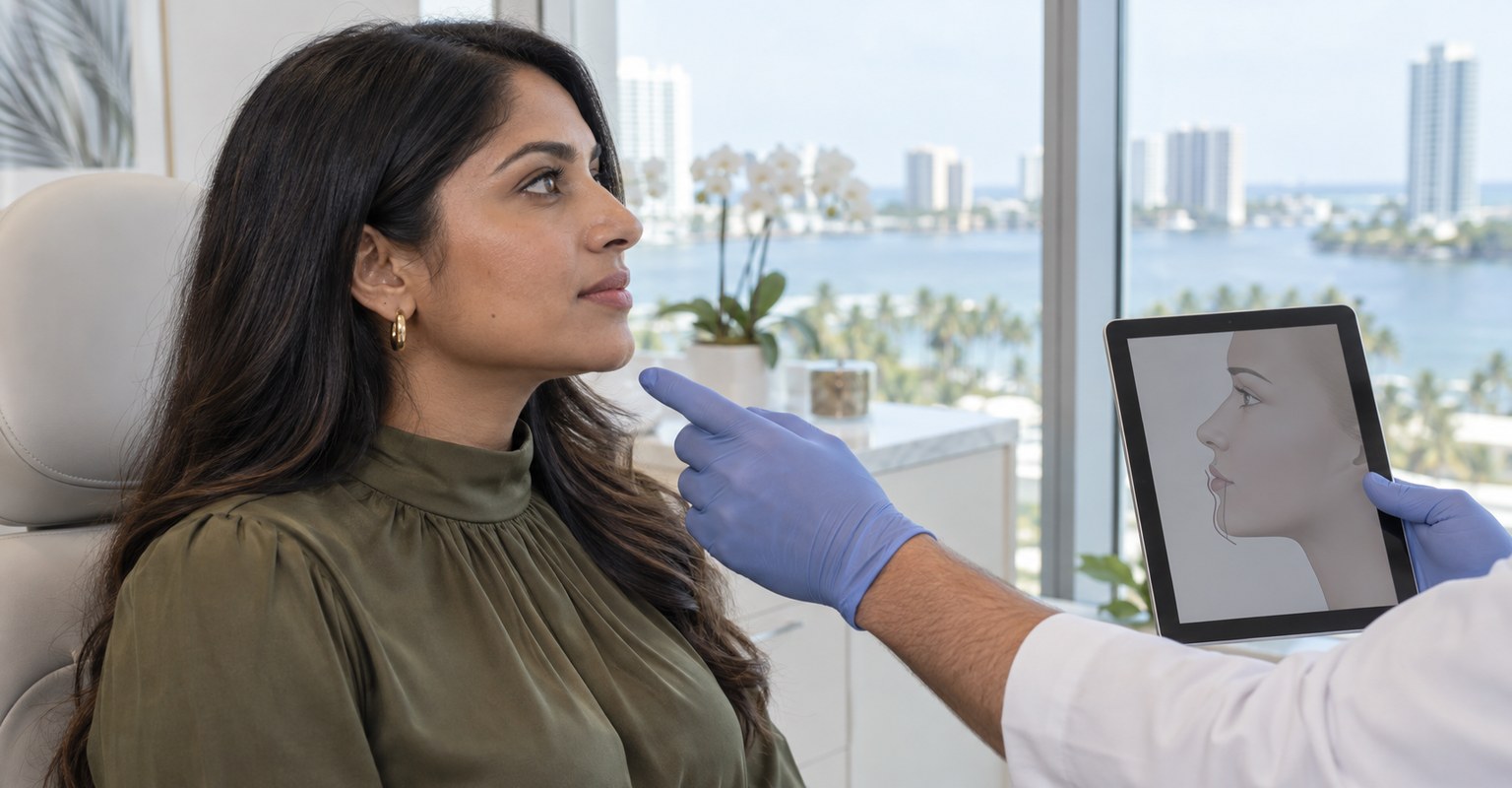


Choosing a chin implant vs filler in Miami is not merely a choice between permanent and temporary. The options differ in how they create projection, how much they can change width or shape, what recovery involves, and what kinds of complications are possible. Filler can be adjustable and may be reversible in some circumstances, while an implant can provide durable structural projection. Neither is automatically better, and neither corrects every reason a chin appears recessed.
Start with the source of the profile concern
A small-looking chin may reflect limited bony projection, lower-jaw position, dental bite, soft-tissue thickness, aging, neck contour, or the visual relationship between the chin and nose. A photograph from the side does not diagnose the cause. Examination should consider the chin from the front, profile, and three-quarter views, along with symmetry, jawline, lip position, skin movement, and dental occlusion.
An implant or filler adds contour at the chin. It does not move the entire lower jaw forward or correct a skeletal bite problem. Symptoms such as difficulty chewing, significant overbite, jaw pain, or sleep-related airway concerns may justify dental, orthodontic, oral-maxillofacial, or sleep evaluation. Cosmetic camouflage can still be discussed, but patients should understand what remains unchanged.
How a chin implant creates projection
A chin implant is a shaped material placed against the front of the lower jaw through an incision under the chin or inside the mouth. Designs vary in central projection, width, and lateral extension. The pocket and implant position influence whether the result looks narrow, broad, tapered, or blended into the jawline. The chin implant and mentoplasty page offers an overview of the surgical option.
An implant can provide a consistent structural change without repeat injections. It can also be removed or exchanged surgically if needed, but that does not make the decision effortlessly reversible. Revision involves another procedure, scar tissue, anesthesia considerations, and the possibility that tissues or underlying bone have changed. Removal may not restore the area to its exact preoperative condition.
How chin filler creates projection
Dermal filler is injected into selected tissue planes to build or refine contour. Small increments can adjust central projection, asymmetry, prejowl transitions, or the visual line between lower lip and chin. The effect is temporary, with duration depending on product, amount, placement, metabolism, and anatomy. Maintenance adds cumulative cost and exposure to repeat procedures.
Only specific filler products have FDA approval for specific indications, age groups, and injection areas. Approval of one product for chin augmentation does not mean every filler is equivalent or approved for that use. Ask for the exact product name, whether the proposed use is on-label, and why its physical properties fit the planned location. The dermal filler page provides broader treatment context.
Reversibility needs careful wording
Hyaluronic acid filler may often be reduced with hyaluronidase, an enzyme used to break down hyaluronic acid. In the United States, using hyaluronidase to dissolve dermal filler is off-label, meaning the FDA has not approved the enzyme for that specific purpose. A qualified clinician may nevertheless consider it if contour is excessive or a vascular complication is suspected. However, dissolving is a medical intervention with its own uncertainty. It may require more than one treatment, can reduce native hyaluronic acid temporarily, may not remove every trace predictably, and does not undo tissue injury that has already occurred.
Fillers made from other materials do not respond to hyaluronidase in the same way. Some are not readily reversible at all. Patients should never accept the blanket claim that all filler can simply be dissolved. The exact product and an emergency plan matter before injection, not only after a problem develops.
Projection, width, and precision
Filler can be useful for a modest, staged change. Because volume is added incrementally, the injector can reassess balance during treatment. Yet filler is not infinitely precise: swelling can temporarily obscure shape, material can migrate or form nodules, and larger volumes may become inefficient or create an unnatural contour.
An implant may be more suitable when a patient wants stronger structural projection or a wider change that matches an available implant design. Implant edges must blend with the existing skeleton and soft tissue. A fixed implant cannot reproduce every custom shape, and asymmetry in the underlying jaw may remain visible. Some patients may be candidates for sliding genioplasty, which moves bone rather than adding an implant, but that is a different operation with different risks and recovery.
How the nose changes the chin conversation
Nasal projection and chin projection influence each other visually. A prominent nose can make the chin appear smaller, while increasing chin projection can make the nose look less dominant without changing it. That optical relationship is useful, but it should not pressure someone into multiple procedures.
When nasal and chin goals coexist, surgeons may discuss staged or combined treatment. Combined surgery can coordinate proportions, but it changes anesthesia time, recovery, cost, and risk. Review the rhinoplasty in Miami guide to understand the nasal side of that decision. Digital imaging may support communication, but it cannot guarantee that healing will match a simulation.
Chin filler risks include rare emergencies
Common injection effects include swelling, bruising, tenderness, redness, and temporary asymmetry. Other complications include infection, nodules, inflammatory reactions, migration, persistent irregularity, and unsatisfactory contour. The most serious filler risk is unintended injection into or compression of a blood vessel. Vascular occlusion can damage skin and cause necrosis. Rarely, filler-related vascular events have been associated with vision loss, stroke, or other severe injury.
Patients should ask whether the injector has anatomy-specific training, uses an appropriate licensed setting, keeps emergency supplies available, and has a written protocol for suspected vascular occlusion. Increasing pain, blanching, dusky or netlike discoloration, cool skin, visual symptoms, severe headache, weakness, or confusion requires urgent action. Visual or neurologic symptoms warrant emergency services.
Chin implant risks and recovery
Implant surgery can involve bleeding, infection, anesthesia complications, numbness, altered sensation, visible or tender scarring, asymmetry, malposition, migration, extrusion, and an unsatisfactory size or shape. Pressure from an implant can be associated with changes in the underlying bone over time. Muscle or nerve effects and the need for removal or revision should also be discussed.
Swelling and tightness are expected to vary. Chewing, oral hygiene, sleeping position, exercise, and return to work depend on the incision and operative plan. An intraoral incision avoids an external chin scar but introduces oral bacteria and may have different aftercare; a submental incision creates a small external scar. Neither route is best for every patient.
Longevity and cost are more than sticker price
Filler usually costs less per session but requires maintenance if the patient wants to preserve the effect. Product longevity estimates are averages, not guarantees. An implant has larger upfront surgical and facility costs but does not require routine replacement on a fixed schedule. It may still need revision for infection, position, preference, or another problem.
Compare full costs: consultation, product or implant, anesthesia, facility, follow-up, time away from work, maintenance, and possible revision. A discounted injection or surgical package should not outweigh product traceability, qualifications, emergency preparation, and continuity of care.
Who may prefer each approach
Filler may fit when
- The desired change is modest and temporary.
- The patient wants to test a general direction before considering surgery.
- Incremental contour adjustment is more important than a large structural change.
- The product, anatomy, and vascular risk have been reviewed carefully.
An implant may fit when
- A durable and more structural increase in projection is desired.
- The available implant shape matches the width and contour goal.
- The patient accepts surgery, recovery, a scar, and possible revision.
- Examination does not point to a jaw or bite problem requiring a different solution.
These are discussion points, not candidacy rules. Some people are better served by no procedure, orthodontic or jaw evaluation, another type of genioplasty, neck treatment, or a revised expectation.
Consultation questions that reveal tradeoffs
- Is my concern caused by chin shape, jaw position, bite, soft tissue, nose-chin balance, or several factors?
- How much central projection and width can each option realistically create?
- Which exact filler or implant would be used, and why?
- If filler is proposed, is it hyaluronic acid and is the product FDA-approved for this indication?
- What is the emergency protocol for suspected vascular occlusion?
- If an implant is proposed, which incision and fixation approach will be used?
- What findings could lead to removal, revision, or referral for jaw evaluation?
- What result range, recovery, maintenance, and total cost should I expect?
Choose the least burdensome option that fits the anatomy
Filler offers a temporary, incremental approach but carries injection risks and is not always simply reversible. An implant offers durable structural projection but requires surgery and can need revision or removal. The right choice follows an anatomical diagnosis, a realistic magnitude of change, and an honest willingness to accept maintenance or operative recovery.
Visit the face procedures hub for related options. To compare a chin implant vs filler in Miami for your goals, request a consultation. This article is general education and does not replace an examination, diagnosis, product review, or individualized informed consent.