

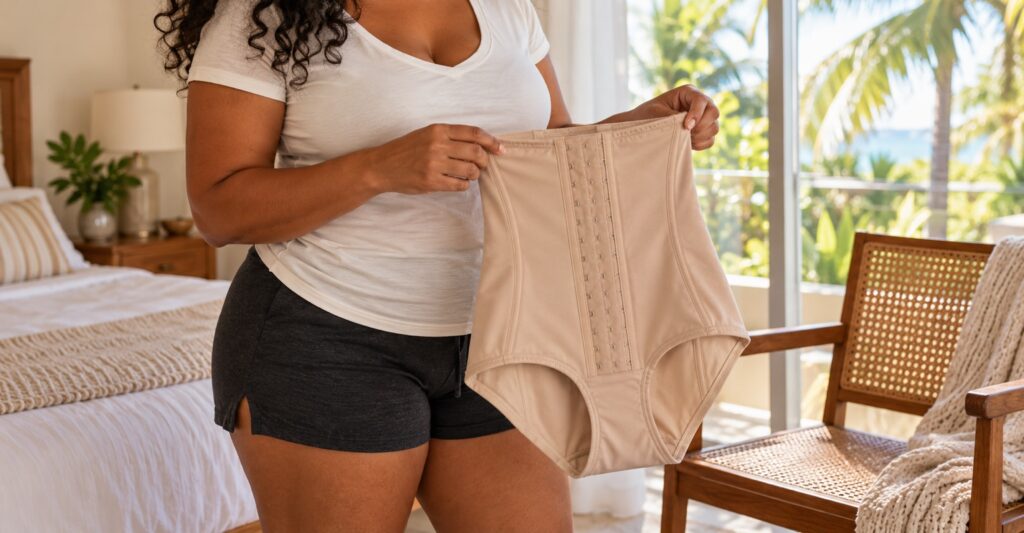
After liposuction in Miami, a compression garment can become part of everyday recovery. The useful question is not which faja looks smallest online. It is which garment, fit, and wear schedule your surgical team recommends for the areas treated and your healing progress. More pressure is not automatically better, and another patient's routine is not a prescription for you.
This guide focuses on garment decisions, not a universal recovery calendar. For an overview of candidacy, treatment areas, and limitations, start with the liposuction procedure page. Your own postoperative instructions take priority over general information.
What a compression garment is meant to do
Surgeons commonly use elastic garments to support treated tissues and help manage swelling. The garment is one part of a plan that can also include incision care, movement restrictions, follow-up visits, and medication instructions. The American Society of Plastic Surgeons' recovery guidance specifically recommends asking how long your pressure garment should be worn.
Compression does not remove additional fat, repair separated abdominal muscles, or replace treatment for loose skin. Nor does it guarantee a particular waist measurement or prevent every contour irregularity. Our discussion of skin elasticity and contouring results explains why skin quality remains important after fat removal.
Research on postoperative compression is not equally strong for every operation or outcome. A published review of compression garments in plastic surgery identifies evidence gaps as well as potential harms from poorly fitted garments. That uncertainty supports individualized instructions, not abruptly abandoning a prescribed garment or tightening it aggressively.
Fit matters more than the size on the label
A postoperative garment should be selected for your current measurements, treatment areas, and the surgeon's intended support. Clothing sizes vary between manufacturers. A garment bought before surgery may need reassessment as swelling changes; a smaller number on the label is not a recovery milestone.
Ask the team to demonstrate how to put it on, position the closures, and check the edges while standing and sitting. Seams, rolling fabric, bunching, or a tight band across one area can create uneven pressure. Tell the team if you need assistance getting dressed or if a closure is difficult to reach without straining.
Comfort alone is not a complete safety check because sensation can be reduced after surgery. Look at the skin when you are instructed to remove the garment, including areas you cannot easily see. New discoloration, blisters, wounds, worsening numbness, or a painful pressure point should be reported promptly. Breathing difficulty is not an acceptable tradeoff for a tighter fit.
How long should you wear it?
There is no single schedule that applies to every liposuction patient. Ask for written instructions covering daily wear, sleeping, showering, laundering, and the appointment at which the plan will be reviewed. The number of treated areas, combined operations, skin condition, and recovery course can change those instructions.
Terms such as stage one and stage two are not a substitute for a clinical assessment. Before buying a different garment, ask whether a change is needed, what features matter, and whether the office should check its fit. A social-media timeline does not establish that your tissues are ready for more compression or that support is no longer needed.
Miami heat calls for practical preparation
Plan a cool place to recover, light outer clothing, and transportation that does not require a long outdoor wait. Miami humidity can make a garment uncomfortable, particularly during errands or travel between appointments. Ask how to handle sweating without improvising a different wear schedule.
Keep the garment clean and dry using its care instructions and the surgical team's directions. Ask whether a second approved garment would help during washing and drying. Inspect covered skin and report irritation, unusual odor, spreading redness, or drainage. These practical precautions are consistent with ASPS guidance on warm-weather recovery.
Discuss pool, ocean, bath, sun-exposure, and exercise restrictions separately from garment instructions. A comfortable fit does not mean an incision is ready for swimming. Do not assume that covering an incision with a garment makes water exposure safe.
Do not add waist trainers, boards, or massage on your own
Show the team any foam, board, extra binder, waist trainer, or recovery accessory you are considering. Ask whether it belongs in your particular plan and, if so, how it should be positioned. Layering products changes pressure and may create a problem that the original garment did not cause.
Firmness or swelling is not automatically a reason for forceful massage. New lumps, persistent fluid-like swelling, or a change that worries you should be assessed before you try to flatten it. Garments also cannot treat every source of abdominal fullness; the distinction between subcutaneous and visceral fat is relevant when setting expectations.
When to contact the surgical team
Contact the office promptly for a garment that feels increasingly painful, damages the skin, or no longer fits as instructed. Rapidly increasing swelling, significant bleeding, fever, spreading redness, foul drainage, or worsening pain also need medical guidance. Do not use tighter compression to conceal a new problem.
Seek emergency care for chest pain, shortness of breath, fainting, or symptoms suggesting a blood clot such as new one-sided leg swelling. A body-contouring garment is not a replacement for the team's blood-clot prevention plan.
Bring these questions to your visit
- Which exact areas need support, and which garment features suit my procedure?
- Can you check the fit both standing and sitting?
- When may I remove it, and how should I wash and dry it?
- What changes require a phone call instead of waiting for follow-up?
- Who should approve a replacement size or additional recovery product?
If you are still planning surgery, contact Dr. Carlos Spera's office to discuss the procedure and its recovery requirements. A useful garment plan should be clear enough to follow at home and flexible enough to be reassessed by the people caring for you.